
Type: Conference Abstract and Poster Presentation
Abstract:
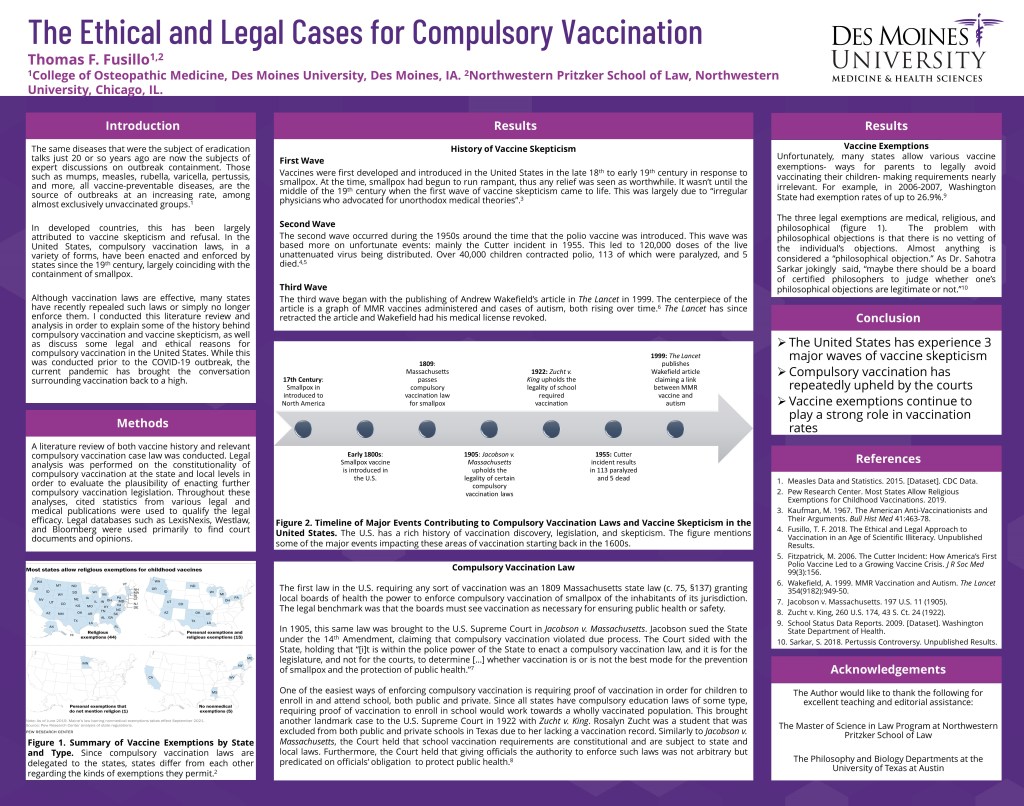
Diseases such as mumps, measles, rubella, varicella, pertussis, and more, all vaccine-preventable diseases, were the subject of eradication discussions in the not-too-distant past, at least in the western world. While research has shown that nearly all compulsory vaccination laws are safe and effective, there has been a resent regression of legislation and/or enforcement of these laws in the United States. I conducted a literature review of vaccine history as well as analyzed case law in order to substantiate the legality and ethics of compulsory vaccination. The first instance of compulsory vaccination was an 1809 Massachusetts law requiring smallpox vaccination. In 1905, the U.S. Supreme Court upheld that law in Jacobson v. Massachusetts, holding that jurisdictions have the right under certain circumstances to pass and enforce compulsory vaccination laws. While the Fourteenth Amendment puts the government under strict scrutiny when it restricts individual liberties, the Court confirmed that it is the legislature’s obligation to pass such laws. Furthermore, in Zucht v. King, the U.S. Supreme Court upheld the right of both public and private schools to require a vaccination record for entrance and attendance. The biggest obstacle to enforcing these laws has been vaccine exemptions. As of 2018, 50 states allowed medical exemptions, 47 allowed religious exemptions, and 17 allowed exemptions based on philosophical beliefs or reason of conscience. This third category is the largest of the three. Further analysis and discussion of this topic should be aimed at vaccination law in the age of COVID-19.
Conference:
11th Annual Des Moines University Research Symposium
Publication Date:
December 3, 2020
 Tom Fusillo, DO, MS, MHA