
David- What We Don’t See

I recently took a nine day trip to Italy and it was phenomenal. My family and I spent 4 days in Tuscany, 1 in Orvieto, and 4 days in Rome. We packed in as much sightseeing as we could and saw and experienced tons of art, history, food, and wine. While it was all fantastic, the one thing that stood out and was the most breathtaking to me was Michelangelo’s statue of David.

One of the days we were in Tuscany we took a day trip to Florence where we went to the Duomo, Baptistry, Art Museum, and the Galleria dell’Accademia where David stands. During all of this we had a personal tour guide who was nothing short of fantastic. He was of German and Italian descent and ironically had his Ph.D. in Philosophy, to which we bonded over. It was his words during the tour that have moved me to write this post and that have provided me with some of the insights and facts this post stands on.

The Galleria is filled with some of Michelangelo’s extremely rare unfinished works, however, it is David that immediately catches one’s eye. Crafted in 1501 and standing at 17 feet tall, the sculpture’s level of detail and beauty is nothing short of perfect. While the artistic and aesthetic aspects of the work are truly great, those are not what gives the piece its true meaning, at least in my opinion.

Most know the story in the Bible of David and Goliath. David, a small child and future king of Israel, defeated and killed the ~7 foot tall Philistine warrior, Goliath. With just a simple slingshot and rock, David used his mind and hands to hurl the rock, crushing Goliath’s forehead. It is this character of David that Michelangelo crafted a marble manifestation of.

So what is the significance of David and Goliath? Well, also back in the 1400’s was a philosopher by the name of Giovanni Pico della Mirandola (Pico). Pico believed that with the power of God and pure human intuition, anyone can overcome any obstacle by using their hands and their head. In other words, by working and thinking. Michelangelo took this and put it into David, literally. Look at David’s hands and head. They’re out of proportion and much too big for his body. How fitting is it for Pico’s position to be crafted onto David, one of the purest symbols of overcoming evil and tribulation?

“Whatever seeds each man cultivates will grow to maturity and bear in him their own fruit.”
-Giovanni Pico della Mirandola

But this goes further. It is awesome that Michelangelo incorporated so much thought into his sculpture, but the true value is in what David stands for. David; relaxed, triumphant, and confident, stands for everything that is good. The statue of David is the biggest threat to those who promote oppression and evil, because David proudly symbolizes everything they try to oppress. All of these oppressive cultures; radical Islam, racial supremacy, political subjugation, etc.. all base their agendas on the idea that certain people do not deserve rights because of their race, religion, political association, etc.. The statue of David and the ideals it represents, however, says the exact opposite.

David represents the concept that no matter who you are, where you’re from, or what your background is, you can defeat and overcome any evil with just your hands and your head. And if one remembers this, than one can never be truly defeated. This has never been more relevant than today. We the people who believe in what is good must never forget what we have and the powers of which we posses. After all, nobody can take your morality unless you let them.


Tom Fusillo
The Airplane Theory

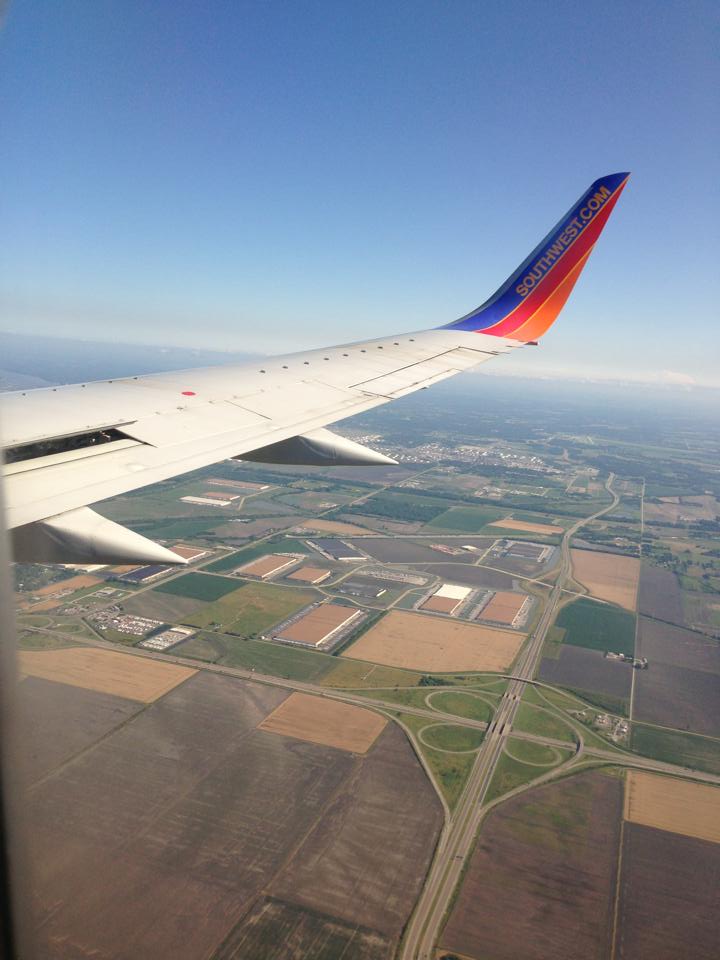
One thing that has always fascinated me are the thoughts that come to mind when I’m on an airplane looking down at the cities and the plains or on the ground looking up at an airplane. While both of these scenarios provoke similar thoughts, they are different. Each possesses its own unique texture. I believe these scenarios are representative of where we are and where we are going.

A few months ago, while I was at work, something happened that happens all the time: a plane about 5 minutes after takeoff from Austin-Bergstrom International Airport caught my eye as it plunged into the white clouds and out of view. Without realizing it, I immediately stopped what I was doing and just stared as the gears of my mind began to churn. The sight of a plane going to some destination that was unknown to me made me think of where I have been, where I am, and where I am going. But it also made me think of the people on board that plane. Who were they, what are their stories, and where are are they going?

As I currently sit on board an eastbound New Jersey Transit train, I am surrounded by people. I will be surrounded by millions more once I arrive in Manhattan, New York, yet we don’t usually look at the people we are (literally) close to. We don’t concern ourselves with the lives of strangers whom we just catch walking past us out of the corners of our eyes. When I look up at a plane however, my head is filled with questions, predictions, and thoughts. From the ground a plane seems miniscule. Its windows the size of buttons and its wings as long as twigs. How crazy something as simple as perspective can be. Chances are, there are over two-hundred people, souls, human lives on board that plane. Each with a different story, each with different pains and triumphs, but all with the same destination. At least for now.

In his poem “The Hollow Men,” T.S. Elliot writes,

The eyes are not here
There are no eyes here
In this valley of dying stars
In this hollow valley
This broken jaw of our lost kingdoms

It seems as if every now and then, when we look straight into someone’s eyes, we see what they’ve seen, feel what they’ve felt, and live what they’ve lived. Looking up at a plane is just a front for this. When you think about it, it makes you think that while some people on that plane may have had a very different past and very different plans going forward, there are also people on that plane that have lived a life similar to yours with goals and ambitions similar to yours. It makes you think that you’re not alone in what you’re trying to do. Most importantly, you realize that what you’re doing has been done before in some capacity.

Life can be much broader once you discover one simple fact: Everything around you that you call life was made up by people that were no smarter than you. And you can change it, you can influence it… Once you learn that, you’ll never be the same again.

-Steve Jobs


Now flip the tables. You’re on the plane coming from some place and going to another. The terrain below appears to be sectioned into quadrants. Buildings that are hundreds of feet tall look as though they barely escape the ground of the planet which now seems so distant. Finally, if you’re still in take-off or approach, you see the cars. What a few hours ago were heavy pieces of forged metal moving at top speeds are now comparable to those little red bugs you’ve seen crawling around your back patio.

Now you are going somewhere. But the people down there? They are there. Wherever it is you are flying over, the inhabitants of that land below are in their place. Their lives are happening. They’re going to work, doing homework, watching TV, showering, & sleeping. They’re also worrying, caring, fearing, hating, and loving. For those people, today is just another day. And for that moment, that individual moment, they aren’t going anywhere. You are.

Yes, there are three letters on your boarding pass abbreviating your destination. You know where you’re headed. I, however, posit that you’re not completely sure where you’re going.  I’m sitting on the plane and I look out of the window at the ground, the sky, and the world, and I can only think about how everything I’ve done and everything I’ve worked for is so that I can finally get to that destination. That place I have in my head that I see myself at. But this puzzle that we call life has variables. Things change. Random twists of our fates happen all the time. So who really knows where we’re going?


After all, we’re only human.


Tom Fusillo


What Do We Have?

The Kubler-Ross Model, otherwise known as the five stages of grief, is something every human being is constantly going through. When first looking at the model one is prone to believe that it is only true in cases of deep trial and tribulation, i.e. the loss of a loved one, divorce, or substance abuse. However, when we look deeper into what our lives and actions consist of, it is clear that we are always in the middle of these stages. When everything circumstantial in this world is taken away it can be concluded that the one thing every human being truly has in this life is their mind.

While some may suppress it more than others, it is the very nature of the human conscience to give us emotions and thoughts that lead us nowhere but deeper into ourselves. The first stage is denial. Deeply, our minds recognize a tragedy, and in most cases we push it away. In the death of a loved one we receive the news, we grieve for a little bit, we hold a service, dress up the dead in clothes to make them look as if they were almost alive, tuck them in a nice box, bury them in the ground, and move on with our lives. However, this is almost never the full story. Our minds will, in its very unique way, chip away at these walls we’ve put up until we are forced to recognize the loss in full. Here we have begun the process of revealing our true self to ourselves. In other words, we start to take in all the little things that we’ve hid from everyone and that we’ve hid from our day to day thought. Just the start.

The second stage is anger. We see this “breaking down” of our defenses quickly approaching and we divert it to anger. We get upset at the world as if just because such a tragedy happened to you it is so much more terrible than if it were to happen to the next person. We blame any supreme beings, maybe we blame a person or group, but in most cases there is nothing reasonable to blame. We understand that grief happens and that it is unavoidable, yet we become enraged when it occurs. It seems that one very logical reason for this is that we don’t want to deal with our thoughts and our mind, and if we can push that encounter [with ourselves] off by being angry, then we will because in the moment it seems like that encounter will never happen.

So why is it that we are so haunted by the idea of facing our own mind? The answer isn’t one that a second year undergraduate philosophy major can easily answer. It’s a broad, theoretical, metacognition. But I can give a partial answer, and that is either; it is just the way we as humans are programmed, or it is how a supreme being has created us in order to cause some greater good later on that we do not currently know of. Of course there is always the Brain in a Vat Theory (ha ha ha). Regardless of the physical (or supreme) reason for this occurrence, I believe that in life it is important to ask the right questions, and the right question here is not “why/what created us this way” but rather “what do we do with this, and how can we use it?”

The third stage is bargaining, aka a last ditch effort to avoid the thing we truly have. After some time, whether it be brief or lengthy, we realize that this anger is either; doing nothing to help the situation, or doing more bad than good. Some people realize this immediately and quickly move from stage 2 to 3, while for some it may take a lifetime. At this bargaining stage we treat the world and God is if it/he is a hostage negotiator. We do what humans do all too well which is pretend like we are in charge, except this time we’re so desperate we’ll offer something up in return. “The third stage is bargaining, aka a last ditch effort to avoid the thing we truly have.” So why is bargaining at this point a last ditch effort? And what are we avoiding by bargaining? To answer the former, it is because subconsciously we know what comes next, and it seems like begging for a revelation is the best option. To answer the latter, stage 4.

Stage four is depression. It is at this stage where my original hypothesis begins to become evident. When we move past the bargaining stage we’ve run out of options. We can no longer tune out the blaring stereo which is our mind. It is as if you can’t stand to listen to yourself anymore, but at the same time that’s all you want in that moment. In this state of depression we tend to become nihilistic and divulge into our mind in what is at first a bad way. We use our mind as an excuse to become anti-social and self-harming. We break into our psyche in a way we never existed. Thoughts flood into our mind. Not necessarily bad thoughts, but thoughts and ideas questioning existence, asking the wrong questions, and driving us insane. Sometimes silence is violent.

These thoughts flood our brain to the point where we can’t turn them off and we feel like screaming but we don’t scream because it just isn’t worth the energy. The stereo keeps blaring in the same room as you, and even though you’re free to leave at any time you can’t help but stay and listen to the sound that you can’t stand. We try and leave this room by getting a hobby or going to a psychiatrist and taking medication, but as Shane Koyczan said, “Sometimes being drug free has less to do with addiction and more to do with sanity.”

What started as a tragedy has turned into something much deeper. With every trial and every tribulation in this life we go just a little deeper into who we are; because after all, there are indeed a lot of secrets we are keeping from ourselves. While the stereo never completely shuts off, in most cases the volume will fade. Maybe just until next time or the time after that, but no matter how brief, we each have our moments of serenity. It is at this point where we come to terms with that original matter.

“Now we are forced to recognize our inhumanity
Our reason coexists with our insanity
But we choose between reality and madness
It’s either sadness or euphoria” -Billy Joel (Summer, Highland Falls)

The fifth and final stage is acceptance. We embrace morality and its circumstances, but more importantly, we embrace the sound. What was for so long a burden has become something else, something different. We’ve come to realize that the one thing we will always truly have in this world to turn to are our own minds. Things will come and go, but as long as we are here, WE will be here. I think that once we get to step 5, everything will be a heck of a lot clearer. Maybe not easier, but clearer.


Thomas Francis Fusillo